
Home

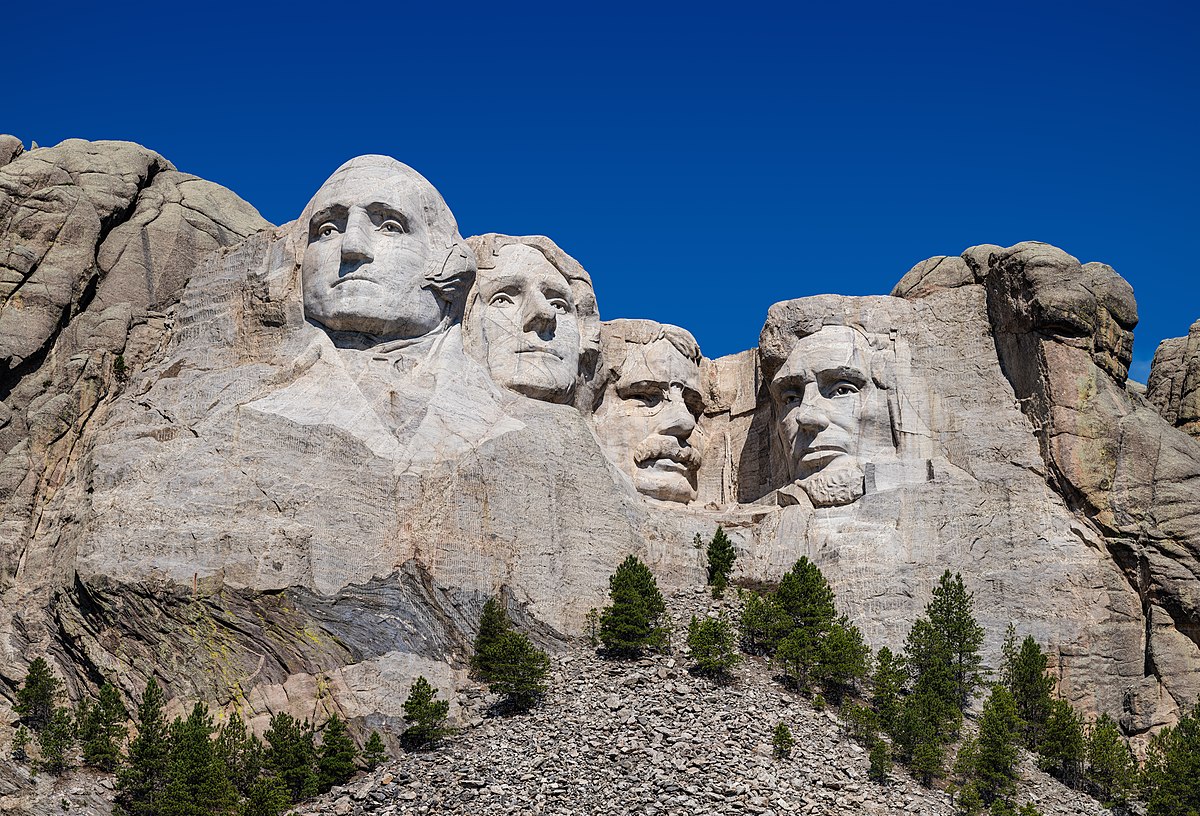
Mount Rushmore, located in the Black Hills of South Dakota, is a colossal sculpture featuring the carved faces of four U.S. presidents: George Washington, Thomas Jefferson, Theodore Roosevelt, and Abraham Lincoln. Each face, measuring about 60 feet tall, was sculpted to represent key moments in American history. Gutzon Borglum, the sculptor, began work on the project in 1927, aiming to create a symbol of American democracy, leadership, and the nation’s expansion.
The project took 14 years to complete, ending in 1941, though it was originally intended to include not just the heads but also the upper bodies of the presidents. The sculpture is carved into a granite mountain, chosen for its durability. Around 400 workers participated in the construction, using dynamite to remove large chunks of rock, followed by finer chiseling to define the facial details. Despite the scale and complexity, no workers died during the project.
Mount Rushmore represents more than just artistic achievement; it’s also deeply symbolic. George Washington was selected for his role in the birth of the United States, Thomas Jefferson for his vision of expanding the nation through the Louisiana Purchase, Abraham Lincoln for his leadership during the Civil War and preserving the union, and Theodore Roosevelt for his role in shaping the country's modern trajectory, including his advocacy for national parks and progressive policies.
The site is one of the most popular tourist destinations in the U.S., attracting nearly 3 million visitors annually. Visitors come to admire the monument, explore the visitor center, and hike the surrounding trails that offer additional views of the sculpture. However, the monument is not without controversy. For some, it stands on sacred land originally belonging to the Lakota Sioux, who see it as a violation of treaties between the U.S. government and Native American tribes.
In recent years, the debate surrounding Mount Rushmore has intensified, with some calling for greater recognition of the Native American history tied to the area. Despite its contentious nature, Mount Rushmore continues to serve as an iconic landmark, representing both American ideals and the complex layers of history that have shaped the nation.